ZH
- EN
- VN
- FR
There are places in Vietnam where history does not merely reside — it breathes. The Temple of King Dinh Tien Hoang, set deep within the limestone-ringed valley of Hoa Lu Ancient Capital, is one such place.
Built in honor of Dinh Bo Linh — the warlord-turned-emperor who unified a fractured Vietnam and founded the nation of Dai Co Viet in 968 AD — this 17th-century temple complex is the beating heart of Hoa Lu’s heritage zone. It is where incense has burned for a thousand years, where stone dragons guard the memory of a king, and where the story of Vietnam’s independence truly begins.
In this guide, Jiva Hoa Lu Retreat takes you through every corner of the temple: its history, its architecture, its legends, and everything you need to know before you visit.
Temple of King Dinh Tien Hoang
Before you step through the Nghi Mon Gate, it helps to understand who you are honoring.
Dinh Bo Linh was born around 924 AD in the region of Hoa Lu, in what is now Ninh Binh Province. Vietnam at the time was not yet a unified nation — it was a patchwork of competing fiefdoms ruled by twelve powerful warlords, a period historians call the Loan 12 Su Quan (the Chaos of the Twelve Warlords).
Legend paints Dinh Bo Linh as a born leader. As a child, he reportedly rallied his village friends into mock military formations using reeds as flags — a story that gave rise to the annual Co Lau Festival still celebrated at Hoa Lu today. As an adult, he proved the legend true. By 968 AD, Dinh Bo Linh had defeated all twelve rival warlords, declared himself Emperor, took the reign title Dinh Tien Hoang (“the First Emperor Dinh”), and established Dai Co Viet — Vietnam’s first officially named independent state after nearly a thousand years of Chinese rule.
He chose Hoa Lu as his capital — deliberately. The valley’s towering limestone karsts formed a natural fortress that no army could easily breach. The mountains were his walls; the Hoang Long River was his moat.
His reign lasted only 12 years. In 979 AD, Emperor Dinh Tien Hoang and Crown Prince Dinh Lien were assassinated. But the nation he built — and the capital he chose — endured. And the temple that bears his name endures still, standing on the very ground where his imperial palace once stood.
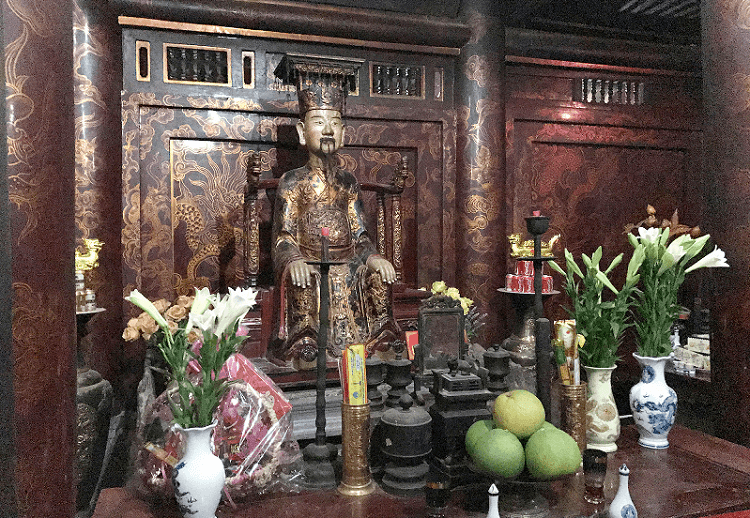
The Temples of Kings Dinh and Le: A Testament to the Ancient Kingdom
The Temple of King Dinh Tien Hoang does not occupy a symbolic location. It stands on the exact site of the former inner palace of Hoa Lu Ancient Capital — the place where Emperor Dinh Tien Hoang once held court, issued decrees, and governed the nation.
After the Ly Dynasty relocated the imperial seat to Thang Long (modern-day Hanoi) in 1010, the original palace structures gradually fell into disrepair. In their place, a series of temples was built over the following centuries to honor the two founding kings of Hoa Lu — Dinh and Le.
The structure visitors see today was reconstructed in the 17th century, during the Le Trung Hung period, incorporating architectural elements from that era while preserving the sacred spatial layout that has defined the site for over a thousand years. Multiple restoration efforts in the 19th and 20th centuries have maintained its integrity, ensuring the complex remains both historically faithful and structurally sound.
In 1962, the entire Hoa Lu Ancient Capital complex — including this temple — was recognized as a National Historical and Cultural Relic by the Vietnamese government. In 2014, it was elevated to a Special National Relic, the highest heritage designation in Vietnam.
The Temple of King Dinh Tien Hoang is not a single building — it is a layered spatial sequence, designed to guide visitors from the ordinary world toward the sacred interior through a succession of gates, courtyards, and sanctuaries. Each element carries symbolic weight.
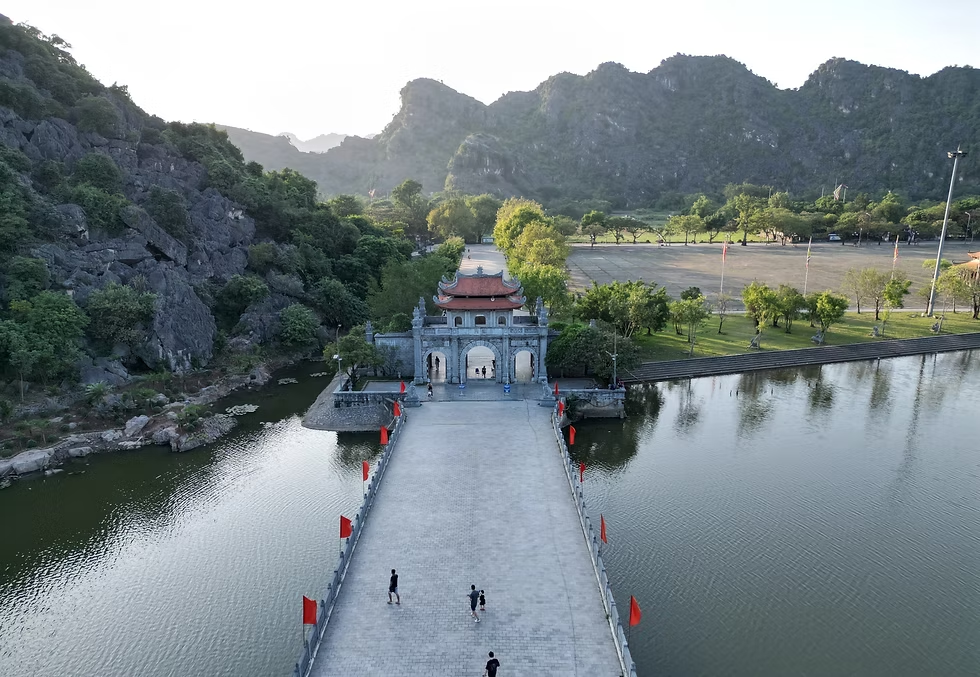
The Nghi Mon Gate (Ceremonial Entrance Gate)
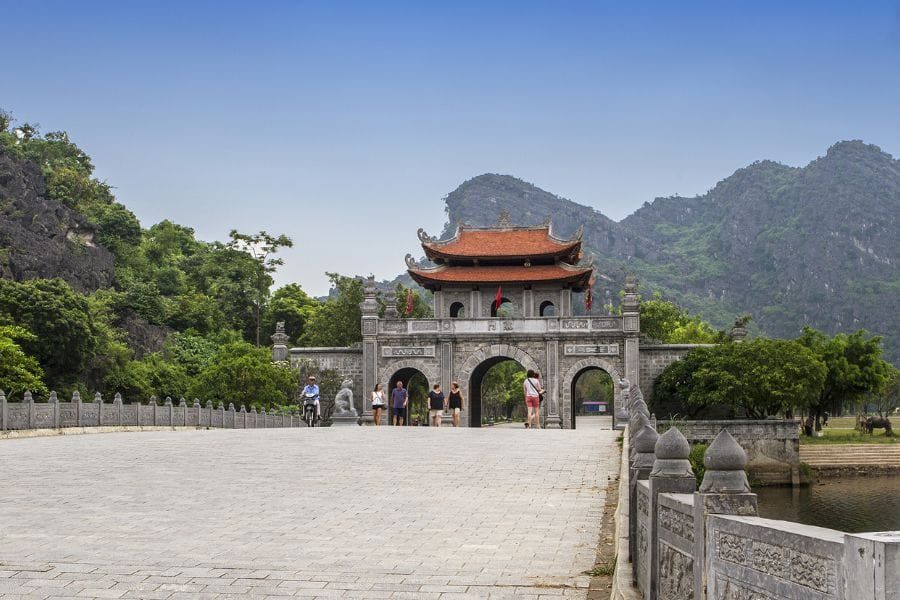
Your visit begins at the Nghi Mon Gate — the grand ceremonial entrance that announces the temple’s presence. Flanked by two stone pillars carved with dragons ascending toward the sky, the gate sets the tone for everything that follows: formal, majestic, deeply Vietnamese in its aesthetic vocabulary.
Two stone lions stand guard on either side, their expressions severe but protective — a visual reminder that you are entering a space of deep spiritual and historical significance.
Passing through the Nghi Mon, you enter a shaded garden courtyard framed by ancient trees. Ahead lies the outer three-entrance gate (Tam Quan Ngoai), followed — after a second courtyard — by the inner three-entrance gate (Tam Quan Noi). This double-gate progression is characteristic of high-status Vietnamese temple architecture, historically reserved for royal and imperial complexes.
The use of three entrances is deliberate: the central gate was reserved for the king and the gods; the side gates for everyone else.
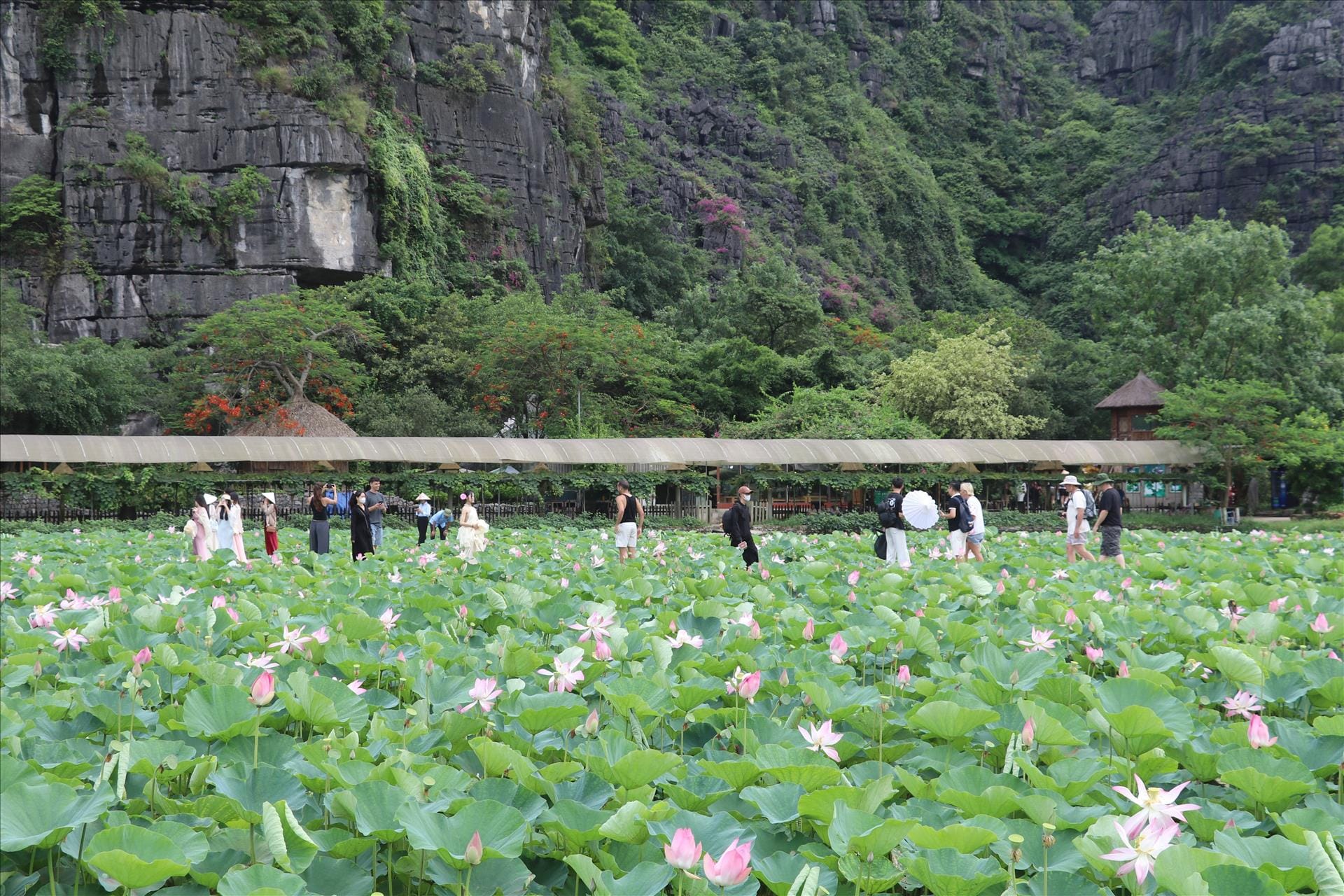
The Lotus Pond
Between the two sets of gates, a tranquil lotus pond reflects the surrounding stone columns and the sky above. In Vietnamese spiritual tradition, the lotus represents purity — the flower that rises from muddy water to bloom immaculate above the surface. Its presence here connects the earthly realm of political history to something more transcendent.
Visit in summer (June to August) to see the pond in full bloom, its pink flowers an arresting contrast against the ancient stone.
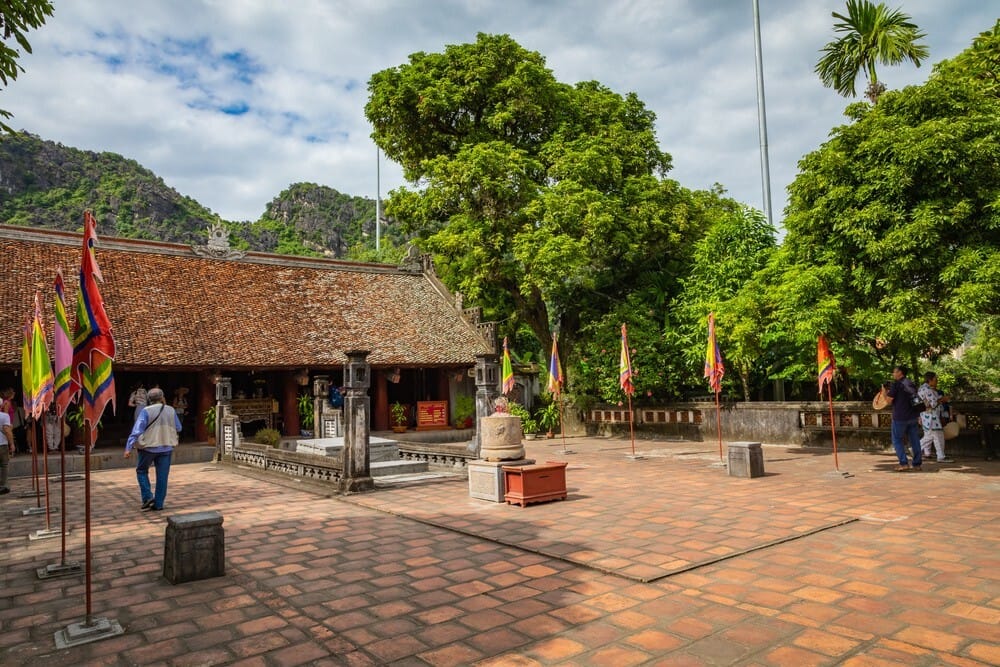
In the main ceremonial courtyard, two of the temple’s most iconic features await: a carved stone throne and a pair of stone elephant statues flanking the approach to the main hall.
The stone throne — where, symbolically, the emperor still sits in judgment — is one of the oldest surviving artifacts in the complex. The elephants, rendered in a style characteristic of 17th-century Vietnamese sculptural tradition, represent loyalty, strength, and royal dignity. Their trunks are lowered — a posture of reverence rather than aggression.
Smaller stone horses stand nearby, completing what was once a full honor guard rendered in stone.
The Main Sanctuary (Hau Cung)
The innermost sanctum of the temple is the Hau Cung — the rear sanctuary where the most sacred statues are enshrined. Here, three principal figures are worshipped in solemn bronze:
The statues date primarily from the 17th and 18th centuries, though several have been restored or recast over the generations. Their faces carry an expression not of triumph but of quiet authority — the composure of rulers who shaped a nation.
The ceiling and beams of the Hau Cung are decorated with carved dragon and phoenix motifs — symbols of imperial power and celestial harmony — finished in lacquered red and gold. Despite the centuries, the craftsmanship retains its original intention: to create a space that feels worthy of the presence it honors.
Throughout the temple complex — on the roof ridges, on the beam ends, on the ceremonial arches — look for the recurring motifs of dragons and phoenixes. In traditional Vietnamese iconography, the dragon (rong) represents the emperor and the power of the heavens; the phoenix (phung) represents the empress and the harmony of the realm. Together, they embody the ideal of balanced imperial rule.
The carving style at Dinh Tien Hoang Temple reflects the Le-era aesthetic: fluid, dynamic dragons with long sinuous bodies, and phoenixes with elaborate feathered tails — visually distinct from the heavier, more stylized forms of later dynasties.
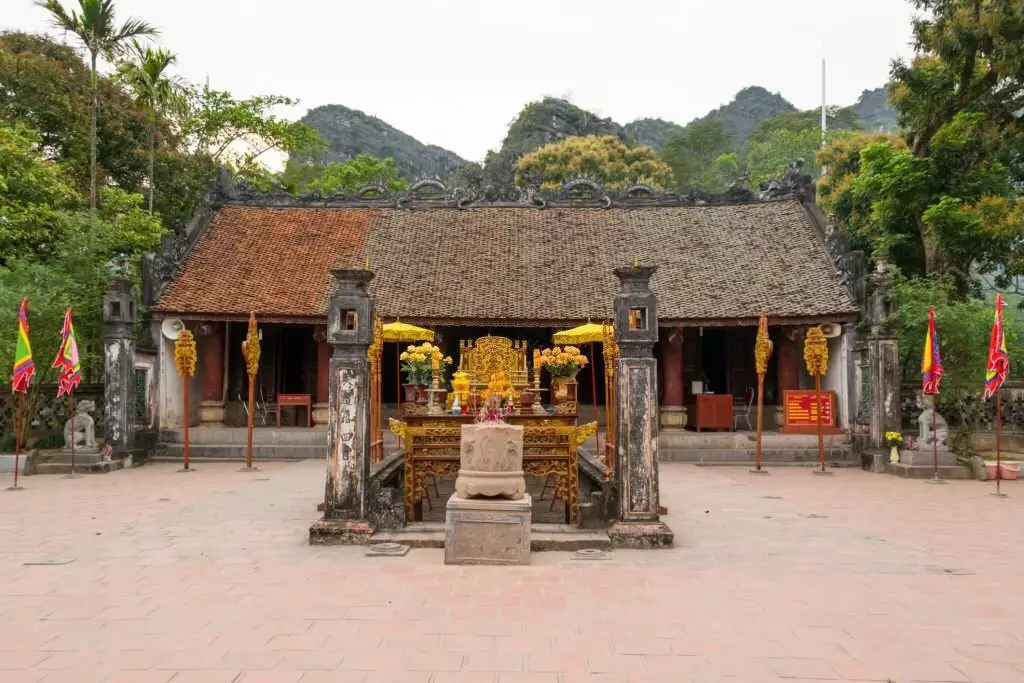
Temple of King Le Dai Hanh: The Essential Companion
Just 500 meters from the Temple of King Dinh Tien Hoang — a five-minute walk through a shaded path — stands the equally important Temple of King Le Dai Hanh, dedicated to Dinh Tien Hoang’s successor.
After the assassination of Emperor Dinh, General Le Hoan seized power and founded the Early Le Dynasty (980–1009 AD), successfully defending Vietnam against a Song Dynasty invasion launched to capitalize on the instability. His temple honors not only the king but also Empress Duong Van Nga — the queen who presided over the dramatic transfer of power — and Prince Le Long Dinh, the last ruler of the dynasty.
The architectural language of Le Dai Hanh’s temple is more refined than its neighbor, featuring ornate floral carvings, a greater emphasis on decorative detail, and a spatial arrangement that feels slightly more intimate. The two temples are best understood as a pair: together, they represent the full 42-year story of Hoa Lu as Vietnam’s imperial capital.
Most visitors walk between the two temples in a single morning — a journey that covers, in physical space, the complete arc of Vietnam’s founding era.
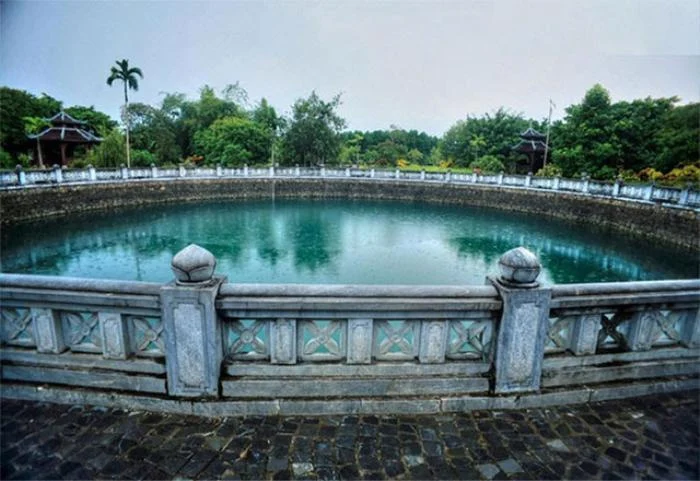
Gieng Ngoc: The Octagonal Jade Well
A short distance beyond the Temple of King Le Dai Hanh, adjacent to the smaller Temple of Princess Phat Kim, lies one of Hoa Lu’s most poignant and historically charged features: the Gieng Ngoc — the Jade Well.
This ancient octagonal well, encased in carved stone, is believed to date to the 10th century. Legend holds that it was the site where Princess Phat Kim — daughter of King Le Dai Hanh — sacrificed herself to preserve her honor during the turbulent final days of the Early Le Dynasty.
The well still contains water, and its stone surround is remarkably intact for its age. It is a quiet, reflective spot, often overlooked by visitors rushing between the main temples — which makes it, paradoxically, one of the most moving places in the entire complex.
Temple of King Dinh Tien Hoang is located within the Hoa Lu Ancient Capital complex, in Truong Yen Commune, Hoa Lu District, Ninh Binh Province — approximately 18 km from Ninh Binh city center, and 95 km south of Hanoi.
For directions and transport options from Hanoi, see our full guide: How to Plan the Best Ninh Binh Day Trip from Hanoi.
The Hoa Lu Ancient Capital complex is open daily: 7:00 AM – 5:00 PM
Early morning (7:00–9:00 AM) is the ideal window — the light is soft and golden, the crowds are minimal, and the incense smoke from the first morning offerings still hangs in the air. The experience at dawn is categorically different from a midday visit.
For the best seasonal conditions, plan around March to May (solar calendar): the weather is cool and clear, the surrounding rice paddies glow green, and the annual Truong Yen Festival (8th–10th of the third lunar month) transforms the entire complex into a pageant of traditional Vietnamese ceremony — water processions, Co Lau battle re-enactments, dragon dances, and cheo ca opera performances.
For a complete picture of when to travel, read our Best Time to Visit Vietnam guide.
As a working spiritual site as well as a historical monument, the temples of Hoa Lu require modest dress. Cover your knees and shoulders. Lightweight linen trousers and a long-sleeved shirt or blouse are comfortable and respectful. Avoid sleeveless tops, shorts, or miniskirts inside the temple buildings.
Comfortable walking shoes are essential — the complex involves considerable walking on uneven stone surfaces, and the path to Am Tien Cave (see below) includes some steps.
The temple complex offers extraordinary photographic opportunities, particularly:
Respectful photography inside the sanctuary is generally accepted, but always be mindful of worshippers.
The Temple of King Dinh Tien Hoang is the essential starting point for a full exploration of Hoa Lu Ancient Capital. To make the most of your time, pair it with these nearby sites:
Am Tien Cave (Tuyet Tinh Coc): Just 500 meters north of the Dinh temple, this secluded valley — with its vast natural lake and history as a royal tiger sanctuary — is one of Hoa Lu’s most visually dramatic and least crowded sites. Allow 45–60 minutes. (Full guide coming soon.)
Nhat Tru Pagoda: A 10th-century Buddhist pagoda with a single stone pillar inscribed with ancient sutras — one of Vietnam’s oldest surviving Buddhist monuments, and a spiritually powerful counterpoint to the Confucian atmosphere of the imperial temples.
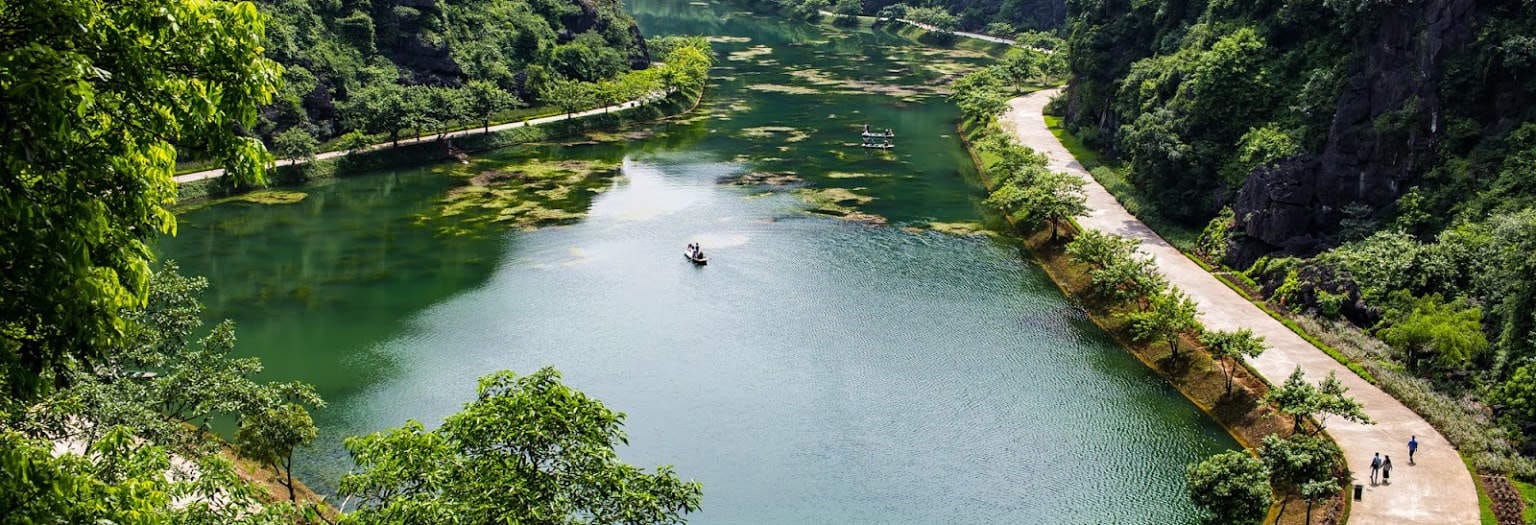
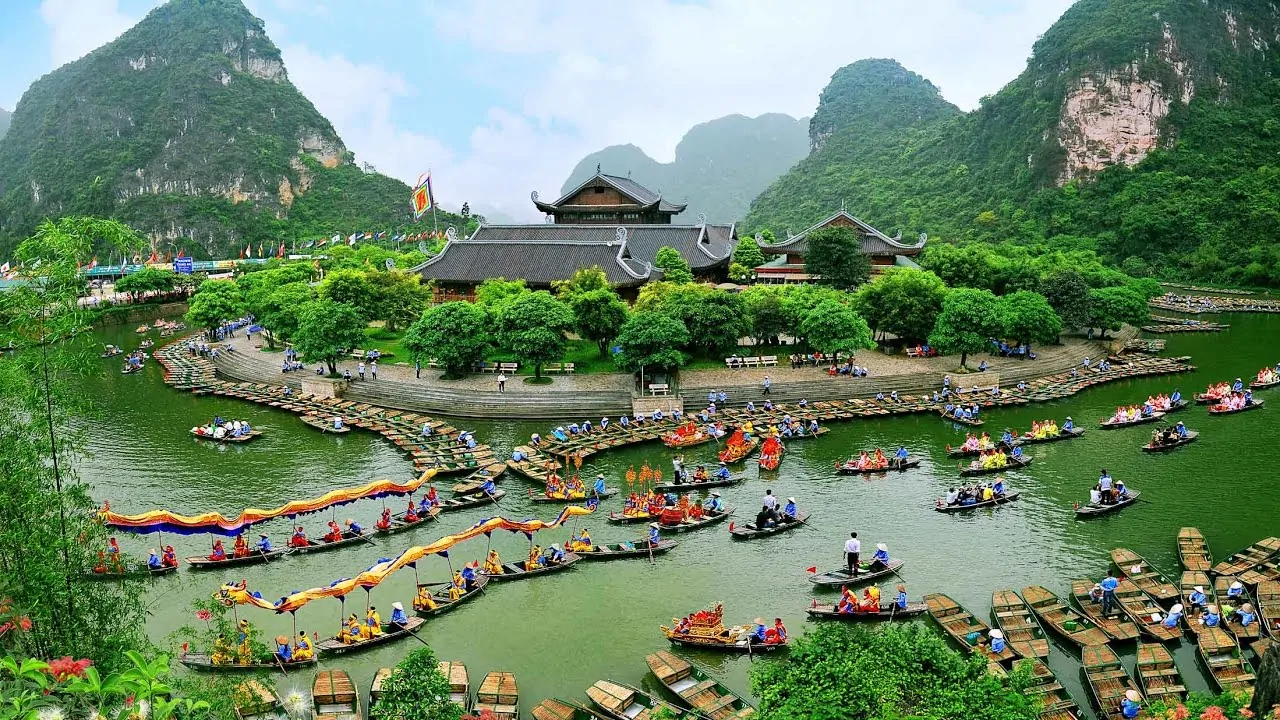
Trang An Landscape Complex: Immediately adjacent to Hoa Lu, the UNESCO-listed Trang An waterway system offers a 2–3 hour sampan boat journey through limestone caves and past cliff-side temples — a perfect afternoon complement to a morning at the Dinh temple.
See our Trang An vs Tam Coc guide to plan your route.
For a complete day plan that sequences all of these sites intelligently, read the Hoa Lu 1-Day Itinerary.
Q: Is the Temple of King Dinh Tien Hoang included in the Hoa Lu entrance fee?
A: Yes. The single entrance ticket of 20,000 VND covers the entire Hoa Lu Ancient Capital complex, including the temples of King Dinh Tien Hoang, King Le Dai Hanh, and the surrounding heritage sites.
Q: How long does it take to visit the temple?
A: Allow 45–60 minutes for the Temple of King Dinh Tien Hoang alone, including time to explore the courtyard, the main sanctuary, and the stone throne area. If you are combining it with the Temple of King Le Dai Hanh, Gieng Ngoc, and Am Tien Cave, plan for 2–3 hours for the full Hoa Lu complex.
Q: Is the temple accessible for visitors with mobility limitations?
A: The main courtyard and outer areas are accessible on relatively flat ground. The inner sanctuary involves a few low steps. Am Tien Cave, by contrast, requires a longer walk on uneven terrain.
Q: Can I hire a local guide at the temple?
A: Unofficial local guides are sometimes available near the ticket gate. For a more structured experience, Jiva Hoa Lu Retreat can arrange guided temple tours for guests — inquire at reception or email us at inquiry@jivahoaluretreat.com.
Q: What is the best way to get to Hoa Lu Ancient Capital from Hanoi?
A: The most comfortable option is a private car (approximately 2 hours). Public limousine buses depart from My Dinh Bus Station to Ninh Binh city, from where a short taxi ride reaches the complex.
See our Ninh Binh Day Trip from Hanoi guide for full details.
Q: Is there a dress code to enter the temple?
A: Yes. Modest dress is required — covered knees and shoulders. Sarongs are sometimes available to borrow at the entrance, but bringing your own is more reliable.
The Temple of King Dinh Tien Hoang is best experienced slowly — at dawn, when the first light touches the Nghi Mon Gate; or in the late afternoon, when the crowds thin and the incense smoke drifts undisturbed. Neither experience is possible on a day trip.
Jiva Hoa Lu Retreat sits within the heritage zone itself — minutes from the temple complex, nestled against the same limestone mountains that once formed the walls of Vietnam’s first capital. From here, you can arrive at the temple before the day-trippers, linger without watching the clock, and return in the evening to the quiet of a valley that has barely changed in a thousand years.
Our villas and suites are designed to reflect the character of the place — local materials, traditional craft, and the absence of noise. Alongside your stay, we offer a curated range of cultural experiences: moonlit fishing, Xam folk music evenings, morning temple walks with local historians, and meditative tea ceremonies in our garden.
This is not just a place to sleep near a landmark. It is a way to inhabit history.
Book your stay at Jiva Hoa Lu Retreat →
Immerse yourself in a stay where northern Vietnamese architecture meets world-class comfort. At Jiva Hoalu Retreat, each accommodation blends locally inspired décor with modern luxuries, offering a unique fusion of culture, tradition, and elegance. Whether you’re here for a romantic getaway, a family escape, or a tranquil retreat, Jiva promises unforgettable moments in the heart of Ninh Binh.
Contact Us:
📞 +84 933 006 886
📧 inquiry@jivahoaluretreat.com
🌐 https://demo.jivahoaluretreat.com/
Book now to enjoy direct booking benefits!
Related reading:
→ Hoa Lu Ancient Capital — Complete Guide
→ Hoa Lu 1-Day Itinerary
→ Trang An vs Tam Coc — Which Boat Route to Choose
→ Best Time to Visit Vietnam
→ Ninh Binh Day Trip from Hanoi
Thank you for your reservation.
You will receive a confirmation from us momentarily
Thank you for reaching out. Your request has been received. Our team will respond within 24 hours.