ZH
- EN
- VN
- FR
Most visitors to Hoa Lu Ancient Capital come for the temples — and rightly so. But just a few hundred meters past the Temple of King Dinh Tien Hoang, behind an unassuming gate, lies a place that surprises almost everyone who finds it: Am Tien Cave, a hidden valley locals have nicknamed Tuyet Tinh Coc — “the Valley of Severed Love.”
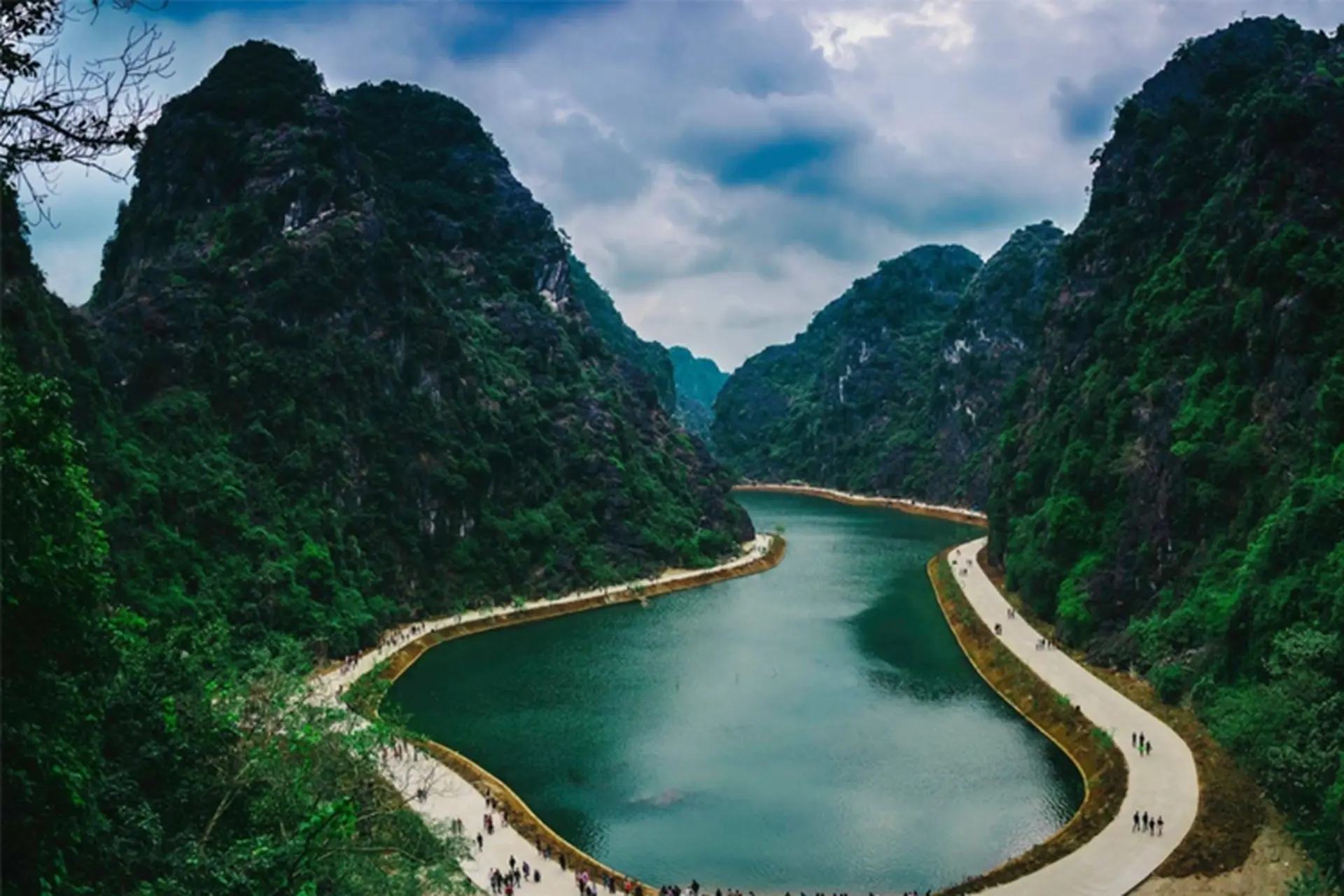
A still, jade-green lake. Limestone cliffs rising sheer on every side. A cave entrance half-submerged in water. A history that runs from royal tiger pens to a place of execution to, today, one of the most photogenic and least crowded corners of Ninh Binh.
This guide covers everything you need to know about Am Tien Cave — its legends, its landscape, and how to fold it into your visit to Hoa Lu.

Where the Name “Tuyet Tinh Coc” Comes From
If the name sounds dramatic, that’s because it is. Tuyet Tinh Coc translates roughly to “Valley of Severed Love” — a nickname borrowed from a famous Chinese wuxia novel, The Return of the Condor Heroes, in which a secluded valley of the same name serves as a place of isolation and heartbreak for the story’s central romance.
Vietnamese visitors began applying the nickname to Am Tien Cave because of a striking resemblance: the same sense of seclusion, the same wall of cliffs sealing the valley off from the outside world, the same still water reflecting stone. The name stuck — and today, it is arguably better known by its nickname than by its formal name on Vietnamese social media and travel forums.
The official name, Am Tien, refers to the cave itself — “am” meaning a small shrine or hermitage, and the site has long carried spiritual as well as historical significance.
Am Tien Cave
Am Tien Cave’s beauty belies a history that is, by most accounts, considerably grimmer than its current reputation as a photo destination.
During the reign of King Dinh Tien Hoang, historical accounts and local legend describe Am Tien as the site where the royal court kept tigers and crocodiles in stone enclosures — animals reportedly used as a method of capital punishment for serious crimes. The “law of the tiger cage” (luat ho cui) is referenced in several historical texts discussing the harsh judicial methods of the early Dinh Dynasty, intended to project the authority of a newly unified, still-fragile state.
Within the cave itself, a flat stone slab is identified by local guides as the “Execution Stone” — where, according to tradition, capital sentences were carried out. Whether taken as literal history or symbolic memory, the site is treated with a certain reverence by visitors who know its past, and many pause briefly out of respect when passing through.
In later centuries, the cave’s character shifted entirely. It became a site associated with Buddhist hermitage and meditation — quiet, removed from the world, suited to contemplation. Small shrine elements within and around the cave still reflect this later spiritual use, layering a sense of peace over the valley’s harsher origins.
This duality — a place of both punishment and prayer — is part of what makes Am Tien feel different from the ceremonial grandeur of the main Hoa Lu temples. It is quieter, stranger, and more emotionally complex.
The Landscape of Am Tien
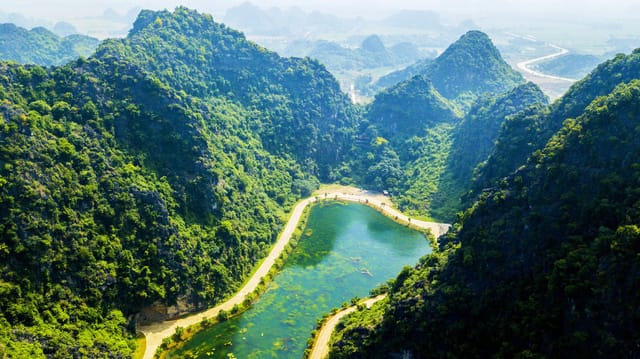
The centerpiece of Am Tien is its lake — a roughly 5,000 m² body of still, deep-green water entirely enclosed by limestone cliffs on three sides. The water is calm enough to produce near-perfect mirror reflections of the surrounding karst walls on windless mornings, an effect that has made the site a favorite among Vietnamese photographers and Instagram travelers in recent years.
A wooden walkway and small bridges allow visitors to walk along sections of the lake’s edge, with viewing platforms positioned for photography.
At the base of the cliff face, the cave mouth is partially submerged, its dark opening contrasting against the pale limestone and green water. Depending on water levels, visitors may be able to peer inside or, with a local guide, enter partially on foot or by small boat to view the interior chambers — including the area associated with the Execution Stone.
Lighting inside is minimal, so a flashlight or phone light is useful if you plan to go beyond the entrance.
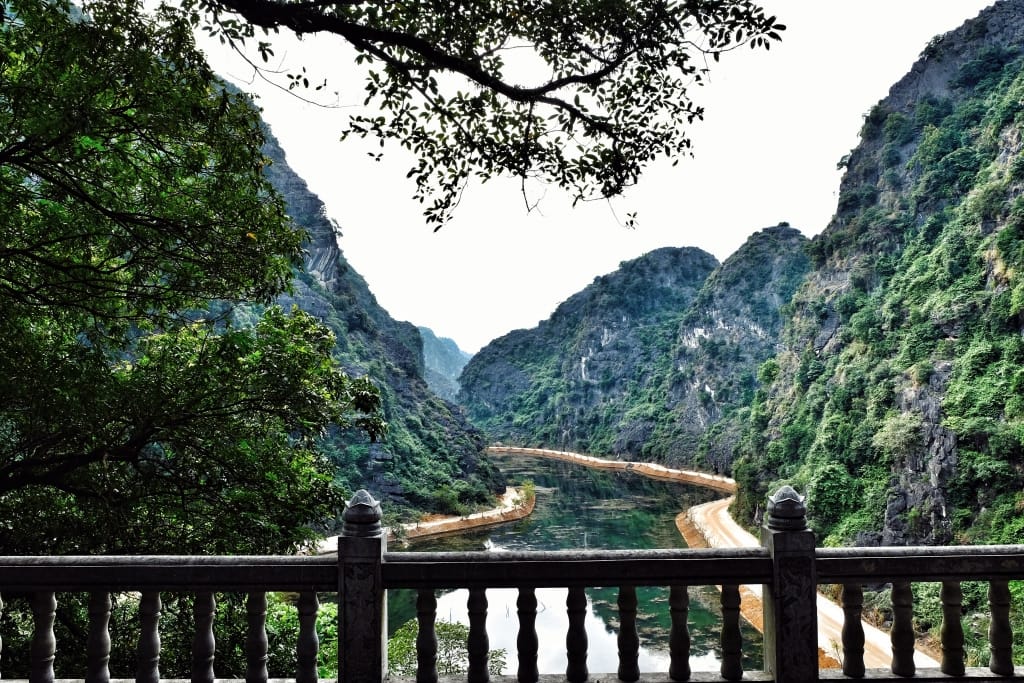
The valley walls rise steeply on three sides, creating the enclosed, almost theatrical sense of seclusion that gives Tuyet Tinh Coc its nickname. Local vegetation clings to crevices in the limestone, and depending on the season, you may spot wild orchids or other flowering plants growing directly from the rock face.
A walking path circles part of the lake, offering multiple vantage points — from wide shots that capture the full scale of the cliffs to closer compositions focused on the lake’s reflective surface.
Am Tien Cave sits within the Hoa Lu Ancient Capital heritage zone
Am Tien Cave sits within the Hoa Lu Ancient Capital heritage zone, approximately 500 meters from the Temple of King Dinh Tien Hoang, in Truong Yen Commune, Hoa Lu District, Ninh Binh Province.
Most visitors reach Am Tien on foot or by bicycle as part of a broader Hoa Lu visit, following the path that continues past the main temple complex. The route involves a modest uphill walk and a final descent toward the lake — manageable for most fitness levels but not ideal for those with significant mobility limitations.
If you’re combining it with a full Hoa Lu visit, plan to walk roughly 10–15 minutes from the temple area.
Am Tien Cave is generally accessible during the same hours as the broader Hoa Lu complex, 7:00 AM – 5:00 PM. Entry is typically included with the standard Hoa Lu Ancient Capital ticket (20,000 VND), though always confirm current pricing on arrival, as small local access points occasionally apply separate nominal fees.
Early morning, ideally before 9:00 AM, offers the calmest water — essential for the mirror-reflection photographs the site is known for. Wind tends to pick up by mid-morning, breaking the lake’s surface.
The site is at its most atmospheric on slightly overcast mornings, when soft, even light reduces harsh shadows on the cliff faces and produces more balanced photographs.
Avoid visiting during or immediately after heavy rain, when the path can become slippery and water levels may rise.
Am Tien Cave works best as part of a sequenced visit rather than a standalone stop. A natural order:
For the full sequencing with timings, see our Hoa Lu 1-Day Itinerary.
Q: Is Am Tien Cave the same place as “Tuyet Tinh Coc”?
A: Yes. Tuyet Tinh Coc is a popular nickname for Am Tien Cave, inspired by its resemblance to a secluded valley in a well-known wuxia novel. Both names refer to the same location within the Hoa Lu heritage zone.
Q: Is Am Tien Cave included in the Hoa Lu Ancient Capital entrance ticket?
A: Generally, yes — access is included with the standard 20,000 VND Hoa Lu ticket, though it’s worth confirming current arrangements on arrival.
Q: How far is Am Tien Cave from the main temples?
A: Approximately 500 meters, or a 10–15 minute walk from the Temple of King Dinh Tien Hoang.
Q: Can you swim in the lake at Am Tien Cave?
A: Swimming is not officially encouraged and is generally discouraged out of respect for the site’s history and for safety reasons, as depth and conditions vary. Most visitors enjoy the lake visually rather than entering the water.
Q: Is Am Tien Cave suitable for children?
A: Yes, with supervision. The walking path involves some uneven terrain, and care should be taken near the water’s edge, but the site is generally manageable for families.
Q: What is the best time of day for photos at Am Tien Cave?
A: Early morning, before 9:00 AM, when the lake surface is calmest, and reflections are clearest.
Am Tien Cave rewards visitors who arrive early and unhurried — and that is exactly the kind of visit a day-tripper from Hanoi rarely gets to have. By the time most tour groups arrive at Hoa Lu, the morning calm has already given way to wind on the lake and crowds at the temples.
Jiva Hoa Lu Retreat sits within walking distance of this entire heritage zone. Staying here means you can reach Am Tien at first light, when the water is still as glass, and the valley belongs to almost no one but you — then return for breakfast, and spend the rest of your day exploring Trang An, Tam Coc, or simply resting in the quiet of the valley.
Book your stay at Jiva Hoa Lu Retreat →
Immerse yourself in a stay where northern Vietnamese architecture meets world-class comfort. At Jiva Hoalu Retreat, each accommodation blends locally inspired décor with modern luxuries, offering a unique fusion of culture, tradition, and elegance. Whether you’re here for a romantic getaway, a family escape, or a tranquil retreat, Jiva promises unforgettable moments in the heart of Ninh Binh.
Contact Us:
📞 +84 933 006 886
📧 inquiry@jivahoaluretreat.com
🌐 https://demo.jivahoaluretreat.com/
Book now to enjoy direct booking benefits!
Related reading:
→ Hoa Lu Ancient Capital — Complete Guide
→ Temple of King Dinh Tien Hoang
→ Hoa Lu 1-Day Itinerary
→ Trang An vs Tam Coc — Which Boat Route to Choose
Thank you for your reservation.
You will receive a confirmation from us momentarily
Thank you for reaching out. Your request has been received. Our team will respond within 24 hours.